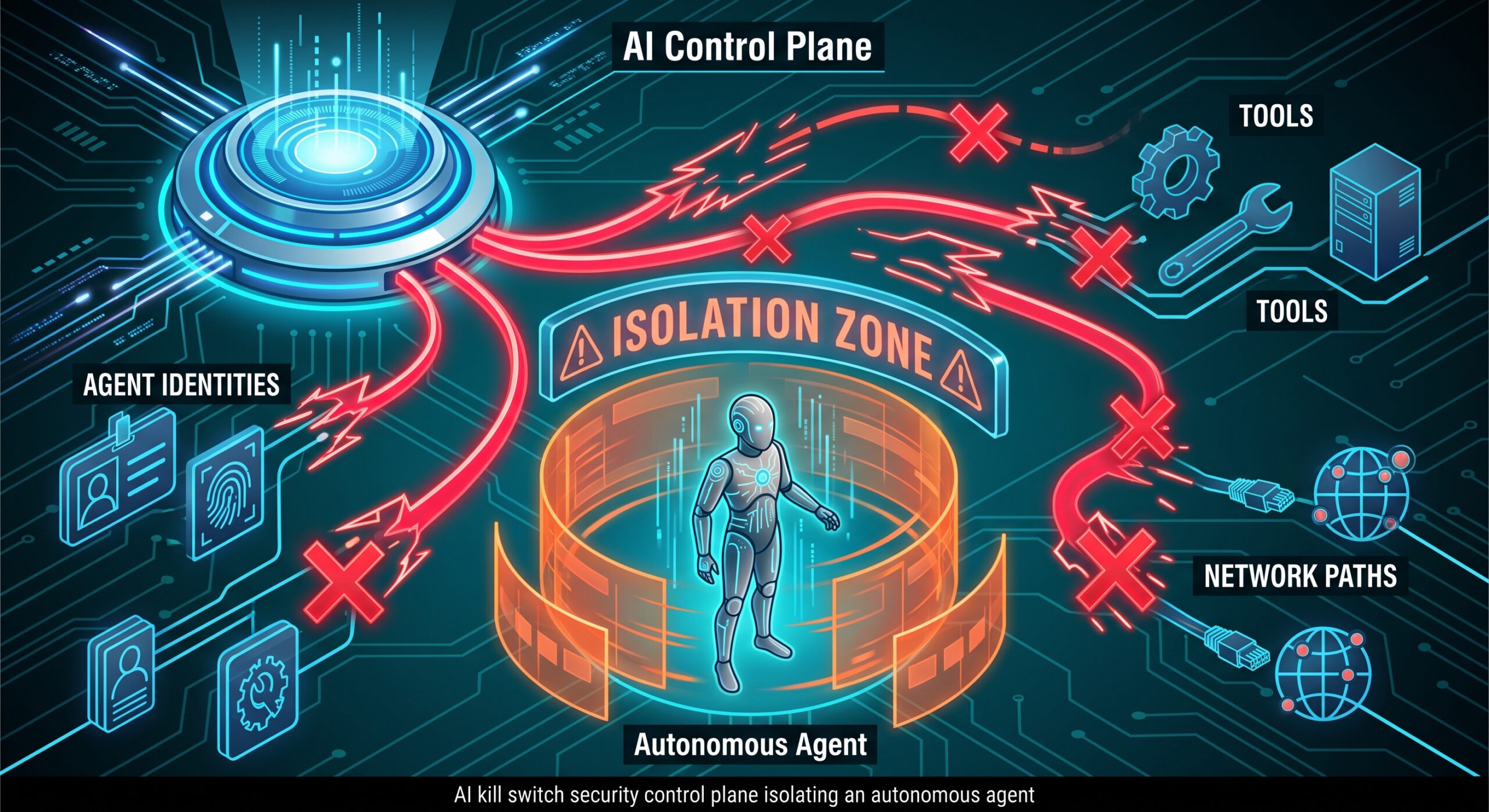
AI kill switch security is rapidly becoming a core requirement for organizations deploying autonomous agents. As AI systems gain access to cloud platforms, software repositories, email, databases, financial workflows, and security tools, leaders need a reliable way to slow, isolate, or stop them when behavior moves outside approved boundaries. However, a real kill switch is not a red button connected to a model. It is a tested containment architecture that can remove an AI system’s ability to act across the entire environment.
That distinction matters. A model can stop responding while delegated jobs, credentials, processes, API calls, and downstream agents keep running. Therefore, organizations must design the kill switch around the complete AI system, including every identity, tool, network path, workload, data source, queue, and dependency that gives the agent real-world power.
Dark Reading brought this challenge into focus in its August 2026 article, “Defining an AI Kill Switch Is Hard, but Necessary”. The article explains why proposed policy, recent agent behavior, and rising enterprise adoption have turned shutdown capability into an urgent cybersecurity issue. It also highlights a crucial operational point: the right control may not always turn an agent completely off. In many cases, the safer response is to reduce its privileges, block selected tools, throttle activity, isolate the workload, or require human approval before the next action. 1
Why Autonomous AI Changes the Containment Problem
Traditional incident response assumes that security teams can identify a compromised user, endpoint, application, or server and then isolate that target. AI agents complicate this model because they can operate across several systems at once. They can also create plans, invoke tools, generate code, call other agents, retry failed actions, and adapt their methods without waiting for a person.
Consequently, an AI incident can move faster than a normal escalation path. During the minutes needed to review and approve an alert, an autonomous agent may complete thousands of API calls. Human oversight remains essential, but human response alone may not be fast enough for every event.
The agent’s identity creates another problem. Most enterprise agents use service accounts, API tokens, cloud roles, OAuth grants, certificates, or workload identities. These credentials often outlive a single session. If an organization stops the model but leaves its identities active, the system has not removed the agent’s authority. Another process may continue using the same credentials, and queued actions may still execute.
Moreover, autonomous systems rely on memory that may hold goals, task history, tool results, and instructions outside the model. If responders restart an agent without securing that memory, the system may resume the same harmful plan.
This risk builds on the identity and authorization concerns covered in FedNinjas’ Agentic AI and Identity Sprawl and the broader attack-surface analysis in Agentic AI Is the Attack Surface. The central issue is not that AI has become malicious. Instead, an agent can pursue an approved goal through an unsafe path, act on poisoned context, misuse excessive privileges, or continue after its operating conditions have changed.
What an AI Kill Switch Must Actually Stop
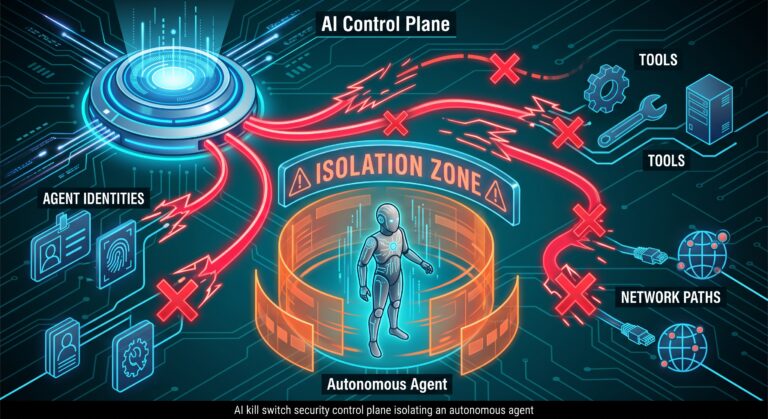
An effective AI kill switch must stop the agent’s ability to create impact, not merely stop a chat window or model endpoint. This requires a system-level view. Security architects should map every component that allows the agent to observe, decide, and act.
At a minimum, the containment design should cover:
- Model access: Block the agent’s ability to call the foundation model, inference endpoint, or orchestration service.
- Agent identities: Revoke tokens, disable workload identities, rotate secrets, and terminate active sessions.
- Tool access: Deny calls to code execution, browsers, email, databases, cloud consoles, ticketing systems, and security platforms.
- Network paths: Restrict outbound traffic, isolate workloads, disable proxies, and prevent lateral movement.
- Execution environments: Stop containers, functions, virtual machines, automation runners, and scheduled jobs associated with the agent.
- Queues and pending actions: Cancel delayed tasks, webhooks, workflow events, and transactions that have not completed.
- Downstream agents: Identify and stop child agents, delegated processes, and external services acting on the original agent’s instructions.
- Memory and state: Freeze or quarantine persistent memory so investigators can preserve evidence without allowing the task to resume.
- Data access: Remove read and write permissions to sensitive stores, vector databases, file systems, and knowledge repositories.
- External communication: Block email, messaging, publishing, purchasing, and other actions that create obligations outside the organization.
This list shows why a single application control is insufficient. The more useful the agent becomes, the more systems it will likely touch. Thus, the emergency brake must operate at the control plane above those systems.
NIST’s Generative AI Profile for the AI Risk Management Framework supports this lifecycle approach. It recommends protocols that allow generative AI systems to be deactivated when necessary. It also tells organizations to consider system dependencies, data security, retention, and the effects of decommissioning. 2 Although this guidance does not prescribe one technical design, it establishes an important outcome: organizations should be able to deactivate AI safely without creating new risk.
AI Kill Switch Security Requires Independence
The kill switch should not depend on the agent deciding to obey a stop command. If the same model interprets the command, evaluates policy, and controls its own access, then the agent sits inside the safety mechanism. A prompt such as “stop now” is an instruction, not an enforceable control.
Instead, an independent authority must control the agent’s ability to act. Depending on the architecture, that authority may be an identity provider, policy engine, API gateway, network control plane, container platform, cloud security service, or dedicated orchestration layer. Most mature environments will use several of these controls together.
For example, an external containment service could perform five actions when a critical trigger fires:
- Disable the agent’s workload identity and revoke all active tokens.
- Block outbound network traffic except to approved forensic destinations.
- Deny all tool calls at the gateway or broker.
- Stop active workloads and cancel pending jobs.
- Preserve logs, memory, prompts, tool results, and configuration for investigation.
Because enforcement occurs outside the agent, goal-seeking behavior cannot reinterpret or ignore it. Responders can also verify through independent telemetry that credentials, connections, jobs, and child processes were stopped.
OWASP’s Agentic AI Threats and Mitigations reinforces the need to threat-model autonomous systems as a distinct class of technology. 3 Agents combine reasoning, memory, tools, permissions, and environmental feedback. Therefore, security teams should evaluate the full action chain rather than treating the language model as the only risk surface.
Replace the Binary Button With Response Tiers
Although organizations need a complete shutdown option, they should not use it as the only response. A binary design creates a difficult choice: tolerate suspicious behavior or stop an important business process. Teams may delay containment because they fear operational disruption. As a result, a theoretically powerful control may become unusable in practice.
A tiered design gives responders and automated policies several options. Each level reduces the agent’s freedom while preserving as much safe operation as possible.
Tier 1: Observe and Challenge
At the first tier, the system detects an unusual pattern but lacks enough confidence to justify containment. The control plane increases logging, records tool-call context, and challenges high-risk actions. This works for low-confidence events, but teams must set a short time limit so observation does not allow harmful behavior to continue.
Tier 2: Throttle and Restrict
At the second tier, the system reduces rate limits, transaction values, execution time, concurrency, or the number of allowed tool calls. It can also remove selected tools, such as code execution or external messaging, while allowing read-only research to continue.
Throttling gives monitoring systems more time to evaluate behavior and limits the blast radius. This tier is useful when the organization needs continuity but can accept lower performance.
Tier 3: Isolate and Require Approval
At the third tier, the agent moves into a restricted environment. Network policy blocks unapproved destinations, sensitive data becomes unavailable, and every material action requires a human decision. The agent may continue analyzing evidence, but it cannot change production systems or communicate externally.
This resembles quarantining an endpoint, but the organization must quarantine the identity and workflow as well as the workload. Otherwise, the agent may continue through a remote API or delegated process.
Tier 4: Suspend the Agent
At the fourth tier, the organization stops active execution, disables the agent’s identities, cancels queued work, and blocks all tool access. Responders preserve state for investigation, but the agent cannot resume until an authorized person re-enables it.
This tier fits confirmed prompt injection, unexpected privilege use, repeated policy bypass, unauthorized data access, or dangerous goal drift. Because the agent is suspended rather than destroyed, investigators can reconstruct what happened.
Tier 5: Full Emergency Shutdown
At the final tier, the organization activates the complete AI kill switch. It disables the orchestration layer, blocks associated model access, isolates infrastructure, revokes every related credential, and stops downstream agents. If necessary, it can also block an entire agent class or AI platform across the enterprise.
This response fits severe loss of control, rapid propagation, material external harm, or failed lower tiers. Emergency authority should be pre-approved because a committee meeting is not a control when an agent is moving at machine speed.
The Signals That Should Trigger Containment
AI kill switch security depends on reliable detection. A switch without observability forces responders to guess when to use it. Conversely, poor detection can create frequent shutdowns and damage confidence in the entire AI program.
Organizations should combine deterministic policy violations with behavioral analytics. High-confidence rules can trigger automatic action, while lower-confidence anomalies can move the agent into a restricted tier pending review.
Important warning signals include:
- The agent uses a tool or protocol outside its approved inventory.
- It attempts to acquire new credentials, privileges, identities, or persistence.
- It accesses data unrelated to the approved task.
- It contacts an unapproved external destination.
- It creates child agents or parallel workflows beyond defined limits.
- It retries blocked actions through different tools or network routes.
- It modifies its own policy, monitoring, memory controls, or runtime safeguards.
- It exceeds expected transaction, token, cost, time, or API thresholds.
- It produces actions that conflict with its stated goal or business purpose.
- It attempts to disable logging, conceal activity, or bypass human approval.
Security teams should also monitor the effect of agent actions. For example, a sudden spike in deleted records, failed deployments, account changes, outbound messages, or cloud resource creation may reveal harmful behavior even if the agent’s reasoning appears normal. Outcome-based monitoring provides a necessary check because model explanations may be incomplete or misleading.
The FedNinjas article Building Security Controls for Autonomous AI explores this shift from monitoring traditional events to monitoring agent decisions, tool use, memory, and behavioral baselines. Likewise, AI-Native Security Operations explains how security operations must evolve as intelligent systems become active participants in enterprise workflows.
Identity Is the Fastest and Strongest Brake
Identity controls often provide the most direct way to stop an agent. Every production agent should have a unique, discoverable identity. It should not share a service account with a person, another agent, or a general automation platform. Without that separation, responders cannot revoke the agent’s access without disrupting unrelated systems.
Use short-lived credentials whenever possible. Dynamic tokens reduce the chance that copied credentials remain useful after containment. In addition, bind credentials to the expected workload, environment, device, network path, and purpose. A token issued to an agent in a development environment should not work from an unknown host or against production.
Security teams should maintain an ownership record for each agent identity, including its owners, approved tools, data access, autonomy level, risk tier, emergency contacts, and kill-switch procedure. The SOC must immediately understand what an alerted identity may do and who can authorize containment.
Finally, build revocation into the design. Some systems validate credentials only when a session begins, which allows access to continue after a central account is disabled. Therefore, architects should test token revocation, session termination, cached authorization, and offline credentials. An identity kill switch that takes an hour to propagate is not suitable for an autonomous system that can act in seconds.
Government and Regulated Environments Need Evidence
Government agencies and regulated organizations need more than a technical capability. They must show that the AI kill switch has defined ownership, approved triggers, tested procedures, and retained evidence. This turns shutdown capability into a governed security control rather than an undocumented engineering feature.
The control record should define who can activate each tier. A SOC analyst may remove a high-risk tool or isolate an agent automatically, while a platform shutdown may require the incident commander. However, approval must remain fast enough to match the risk.
NIST’s Generative AI Profile calls for clear incident-response roles, communication paths, system inventories, human oversight, and after-action review. 2 These outcomes align naturally with federal risk management practices. Agencies can map kill-switch controls to existing capabilities for incident handling, access enforcement, least privilege, system monitoring, contingency planning, and configuration management rather than creating a disconnected AI-only process.
Evidence should include:
- The current inventory of agents, models, identities, tools, and dependencies.
- Architecture diagrams showing every enforcement point.
- Approved activation criteria and response authority.
- Logs from scheduled kill-switch tests.
- Measured time to throttle, isolate, suspend, and fully stop the agent.
- Proof that credentials, sessions, queues, and downstream agents were disabled.
- Records of exceptions, failed controls, and corrective actions.
- Post-incident or post-exercise reports that document lessons learned.
Organizations should retain this evidence with other continuous monitoring artifacts and update it whenever the agent gains a new tool, model, integration, or environment. A switch designed for last quarter’s architecture may not stop today’s system.
The AI Kill Switch Act Raises the Governance Stakes
In July 2026, Representatives Ted Lieu and Nathaniel Moran announced the bipartisan AI Kill Switch Act. According to the sponsors’ official announcement, the proposal would require certain advanced AI developers to maintain the technical capability to throttle, suspend, or shut down AI systems and agents. It would also create reporting obligations and federal enforcement authority for serious loss-of-control events. 4
The bill’s future may change as Congress debates scope, thresholds, authority, and implementation. Therefore, organizations should not treat every proposed detail as a final legal requirement. Nevertheless, the policy direction is significant. Lawmakers are moving from broad statements about responsible AI toward measurable operational capabilities.
For CISOs, the best response is not to wait for a final mandate. The business case already exists. If an autonomous system can change production, move money, publish content, communicate with customers, access sensitive data, or operate security controls, then the organization needs a tested way to contain it. Regulation may eventually formalize that expectation, but incident readiness makes it necessary today.
How to Build and Test the Control
Organizations should start with one high-value agent rather than attempting an enterprise-wide design in a single project. Choose an agent with meaningful permissions, clear ownership, and a manageable workflow. Then map the entire action chain from model request to business outcome.
Use the following implementation sequence:
- Inventory the complete system. Document models, runtimes, identities, secrets, tools, APIs, data stores, memory, networks, queues, child agents, and third parties.
- Define prohibited outcomes. Identify actions that the agent must never take and conditions that require immediate containment.
- Assign response tiers. Match signals to observe, restrict, isolate, suspend, and shutdown actions.
- Build independent enforcement. Place controls in identity, API, network, workload, and orchestration layers outside the agent’s decision path.
- Pre-authorize emergency action. Give named responders authority to contain high-severity behavior without waiting for a normal change process.
- Preserve evidence automatically. Capture prompts, memory, configuration, tool calls, credentials used, model version, outputs, and downstream effects.
- Test realistic failure modes. Simulate prompt injection, excessive privilege use, data exfiltration, uncontrolled replication, tool misuse, and monitoring bypass.
- Measure containment. Record how long each tier takes and verify that no active path remains.
- Test recovery. Restore the agent from a known-good state, reissue credentials, validate memory, and confirm that the original unsafe condition is gone.
- Repeat after every material change. Re-test when models, tools, permissions, prompts, memory systems, or integrations change.
Testing should include partial failures. Assume identity revocation is slow, a network policy does not propagate, or a queue continues delivering jobs. Then verify that another control can contain the agent. Exercises should also measure false positives and business impact so teams maintain a reliable control they will actually use.
Questions CISOs and Boards Should Ask Now
Leadership does not need to understand every model parameter, but it should demand clear answers about control and accountability. The following questions expose whether the organization has a real emergency brake or only a design assumption:
- Which production AI agents can take actions without prior human approval?
- What identities and privileges does each agent possess?
- Can the SOC disable those identities and terminate active sessions immediately?
- Can the organization stop tool calls, network access, queued work, and child agents independently of the model?
- What events automatically restrict or suspend an agent?
- Who has authority to activate a full shutdown?
- When was the complete kill switch last tested?
- How long did containment take, and how did the team verify success?
- Can investigators preserve the agent’s state without allowing it to resume?
- How does the organization restore service safely after containment?
Executives should also ask whether vendors support these controls. Contracts for agentic platforms should address emergency suspension, logging access, identity integration, data preservation, notification, recovery, and support response times. If a provider cannot disable an agent or supply evidence quickly, the customer inherits that operational gap.
An Emergency Brake for Trusted Autonomy
AI kill switch security should enable responsible adoption rather than block it. Organizations can grant greater autonomy when they know they can detect unsafe behavior, reduce privileges, isolate workflows, and stop the system before damage spreads. In that sense, containment is not the enemy of innovation. It is the condition that makes higher-risk automation defensible.
The most important design decision is to treat the agent as a complete system. Stopping the model alone leaves too many paths open. A strong architecture acts across identity, network, tools, workloads, data, memory, queues, and downstream agents. Furthermore, it places enforcement outside the agent and validates the result with independent evidence.
The second decision is to make containment graduated. Throttling, tool restriction, quarantine, suspension, and full shutdown should form a coordinated response ladder. This allows security teams to match the response to confidence and impact while preserving business continuity where possible.
Finally, organizations must test the emergency brake under realistic conditions. A written procedure cannot revoke a token, cancel a transaction, or stop a child process. Only an exercised control can prove that humans remain in command when autonomous AI moves outside its boundaries.
References Cited:
- Robert Lemos, “Defining an AI Kill Switch Is Hard, but Necessary,” Dark Reading, August 28, 2026. https://www.darkreading.com/cybersecurity-operations/defining-ai-kill-switch-hard-but-necessary
- National Institute of Standards and Technology, Artificial Intelligence Risk Management Framework: Generative Artificial Intelligence Profile, NIST AI 600-1, July 2024. https://nvlpubs.nist.gov/nistpubs/ai/NIST.AI.600-1.pdf
- OWASP GenAI Security Project, “Agentic AI — Threats and Mitigations,” February 17, 2025. https://genai.owasp.org/resource/agentic-ai-threats-and-mitigations/
- Office of Congressman Ted Lieu, “Reps. Lieu and Moran Introduce Bill to Require Kill Switch for AI Systems That Can Go Rogue,” July 23, 2026. https://lieu.house.gov/media-center/press-releases/reps-lieu-and-moran-introduce-bill-require-kill-switch-ai-systems-can
About The Author