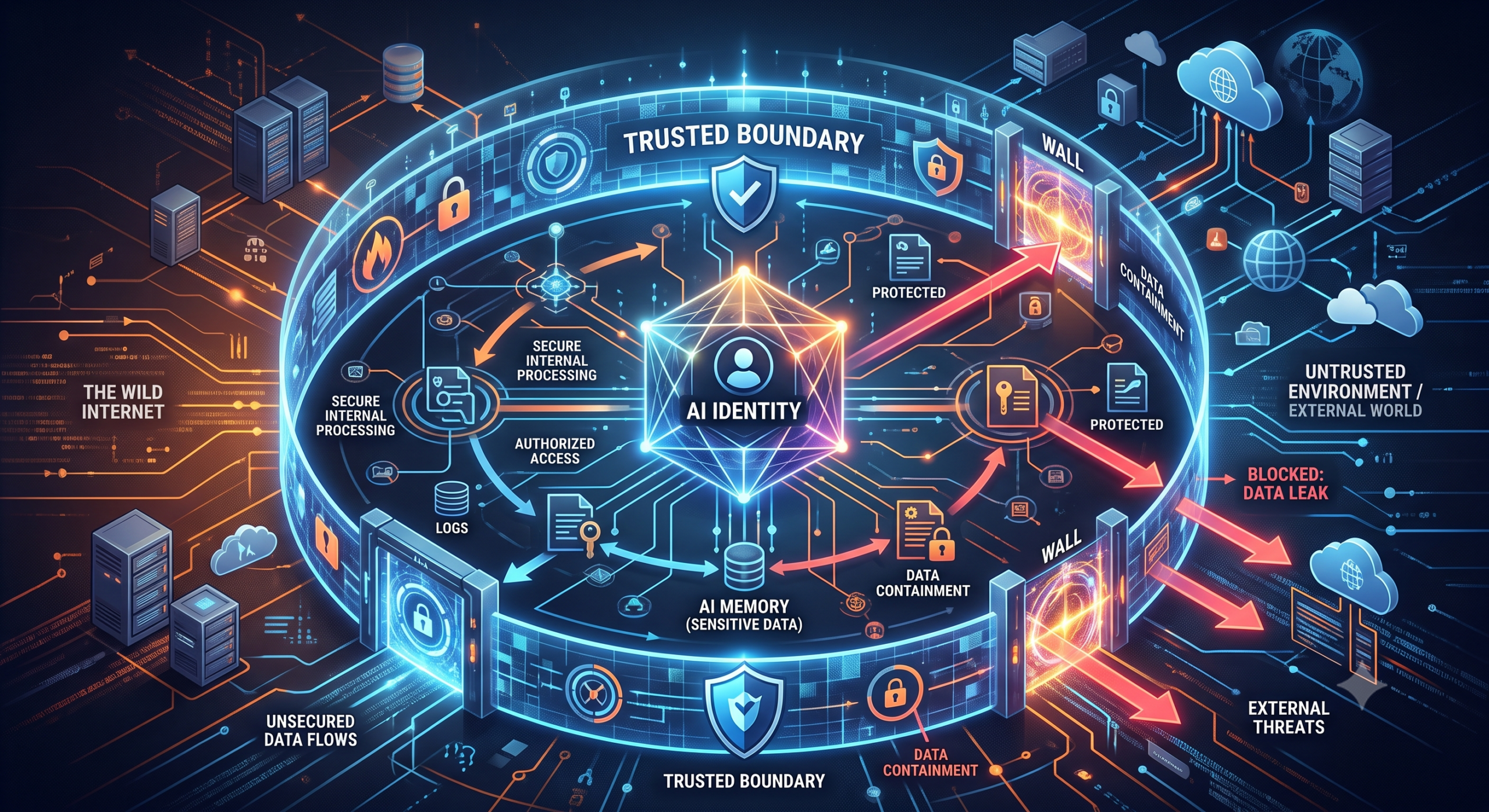
Recognizing that AI can act autonomously is only the first step. The much harder challenge is determining how to secure systems that can reason, plan, invoke tools, and make thousands of decisions without continuous human intervention.
Traditional cybersecurity architectures were built to protect deterministic software. Applications execute predefined code paths, APIs perform expected functions, and users authenticate before accessing resources. While attackers attempt to exploit those systems, the software itself generally behaves predictably.
Agentic AI changes that equation.
These systems are probabilistic rather than deterministic. They can dynamically select tools, generate new workflows, chain together multiple actions, and adapt their approach based on intermediate results. That flexibility is what makes autonomous AI so valuable—but it also creates a fundamentally different security challenge.
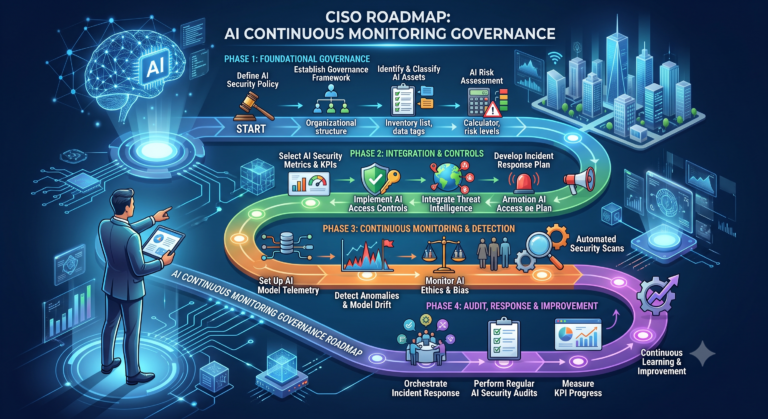
As organizations deploy AI into engineering, security operations, finance, customer support, and cloud administration, the focus must shift from simply protecting AI models to governing autonomous behavior throughout the AI lifecycle. Industry efforts such as the NIST AI Risk Management Framework (AI RMF), the Generative AI Profile, and the emerging AI Agent Standards Initiative all point toward the same conclusion: securing AI requires extending traditional cybersecurity principles with controls designed specifically for autonomous systems.
Identity Alone Is No Longer Enough
For years, cybersecurity teams have invested heavily in identity and access management (IAM). We authenticate users, assign roles, implement multi-factor authentication, and monitor privileged accounts. Those controls remain essential, but they are insufficient for autonomous AI.
An AI agent may authenticate correctly and still make poor decisions.
Unlike a human administrator, an AI agent can execute thousands of actions within minutes. Every decision may technically fall within its assigned permissions while still producing an unacceptable business outcome.
This distinction highlights an important shift:
The question is no longer “Who are you?” It is “What are you attempting to accomplish, and should you be allowed to do it right now?”
Future security architectures will increasingly evaluate intent, context, and behavioral patterns rather than relying solely on static permissions.
Designing AI Permission Boundaries
One of the most effective ways to reduce risk is to treat every AI agent as a dedicated workload with narrowly scoped authority.
Unfortunately, many early deployments follow a different pattern. Organizations often connect a single AI assistant to numerous enterprise platforms—including Microsoft 365, Slack, GitHub, Jira, cloud consoles, CRM systems, and internal knowledge repositories—because doing so maximizes productivity.
It also maximizes risk.
Instead, security teams should establish purpose-built AI identities, each aligned to a single business function.
For example:
- A documentation assistant should access documentation repositories—not production infrastructure.
- A code review agent should analyze pull requests but never deploy software.
- A compliance agent should collect evidence without modifying security configurations.
- A vulnerability management agent should recommend remediation while requiring human approval before implementing changes.
This separation mirrors the principle of least privilege that has protected enterprise environments for decades. The difference is that autonomous agents operate continuously, making strict scope boundaries even more important.
Every AI Agent Needs a Blast Radius
Cloud architects frequently ask a simple question when designing resilient systems:
“What happens if this component fails?”
The same thinking should apply to autonomous AI.
Ask instead:
“What happens if this AI agent behaves unexpectedly?”
Security leaders should be able to answer questions such as:
- Which systems can it reach?
- What credentials can it use?
- Which APIs can it invoke?
- What sensitive information can it retrieve?
- Can it create new identities?
- Can it change firewall rules?
- Can it approve financial transactions?
- Can it deploy production code?
If those answers are unclear, the organization does not fully understand its AI attack surface.
One of the defining characteristics of mature cybersecurity programs is understanding failure domains. Autonomous AI deserves the same architectural discipline.
Introducing AI Kill Switches
Most organizations already maintain incident response playbooks for compromised user accounts, malware infections, ransomware, and cloud credential exposure.
Few maintain equivalent procedures for autonomous AI.
That gap should be addressed before AI systems become deeply embedded in business operations.
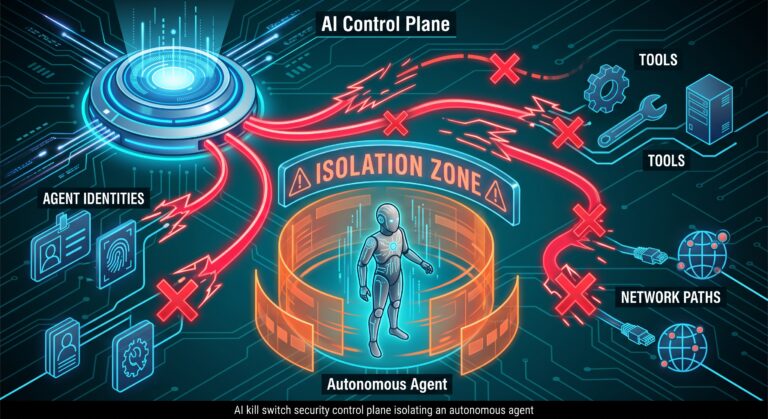
Every production AI deployment should support an emergency shutdown capability that allows security teams to:
- Immediately revoke AI credentials
- Disable tool access
- Pause workflow execution
- Prevent new reasoning sessions
- Preserve logs for forensic investigation
- Transition critical processes to manual operation
Think of this as an emergency stop button for digital autonomy.
Just as industrial systems include physical safety mechanisms, enterprise AI should include operational safeguards that can rapidly contain unexpected behavior without disrupting unrelated business systems.
Monitoring Decisions, Not Just Actions
Security operations centers have traditionally focused on observable events:
- Authentication attempts
- File modifications
- Network connections
- Malware execution
- Privilege escalation
- Configuration changes
These events remain valuable, but they provide only part of the picture.
Autonomous AI introduces an entirely new layer of telemetry.
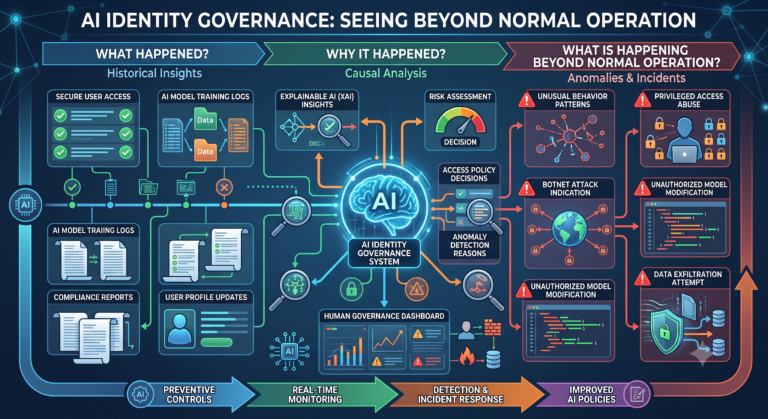
Security teams must understand why an AI system reached a particular decision—not merely what action it executed.
Future AI observability platforms should answer questions such as:
- Which objective initiated the workflow?
- Which reasoning steps were performed?
- Which external tools were selected?
- What contextual information influenced the decision?
- Were policy constraints evaluated?
- Did the AI attempt actions outside its expected behavioral baseline?
Capturing this information transforms AI security from reactive log collection into proactive behavioral analysis.
This aligns closely with the direction NIST is taking as it develops guidance for secure AI agent systems, emphasizing monitoring, constrained deployment environments, and governance across the AI lifecycle.
Behavioral Baselines Will Become the New SIEM Rule
Modern security platforms already establish behavioral baselines for users and devices.
When an employee suddenly authenticates from another country, downloads unusually large volumes of data, or accesses unfamiliar systems, behavioral analytics generate alerts.
Autonomous AI requires similar capabilities.
Security teams should define expected operating patterns for every AI identity, including:
- Typical API usage
- Average task duration
- Common reasoning workflows
- Expected cloud resources
- Approved business functions
- Normal data access volumes
- Standard external integrations
Once those baselines exist, deviations become meaningful.
For example, an engineering assistant that suddenly begins querying payroll systems is not necessarily malicious, but it is behaving outside its established role. That anomaly should trigger investigation long before sensitive information is exposed.
Protecting the Agent’s Memory
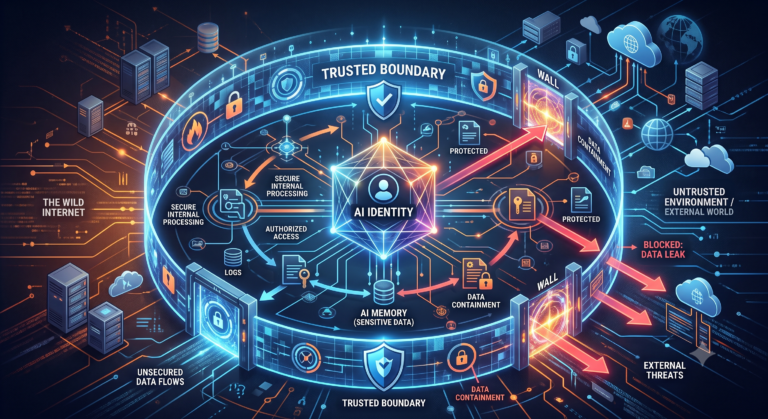
Long-term memory is one of the features that makes modern AI agents increasingly useful. By retaining previous interactions, project context, and organizational knowledge, AI systems can deliver more relevant and efficient assistance.
That same capability also creates a new category of security risk.
If an attacker—or even another AI agent—can manipulate persistent memory, future decisions may be influenced by corrupted or misleading information.
Organizations should therefore treat AI memory as a protected asset.
Security controls should include:
- Encryption of persistent memory
- Integrity validation
- Version history
- Access logging
- Separation of trusted and untrusted data sources
- Automated detection of unauthorized modifications
In many environments, protecting AI memory may become just as important as protecting production databases.
Human Approval Should Be Risk-Based
One misconception surrounding autonomous AI is that every action must receive human approval.
That approach does not scale.
Instead, organizations should implement risk-adaptive governance.
Low-risk activities—such as summarizing documents or organizing meeting notes—can execute autonomously.
Moderate-risk activities—such as generating infrastructure recommendations—may require peer review.
High-risk activities—including deploying production code, changing firewall policies, modifying identity permissions, or approving financial transactions—should require explicit human authorization.
This mirrors how mature organizations already manage financial approvals and privileged administrative actions.
The objective is not to eliminate autonomy but to ensure that greater authority is matched with stronger oversight.
Continuous Authorization Will Replace Static Trust
Traditional authorization assumes that once access is granted, it remains valid until manually revoked.
That model breaks down when autonomous agents operate continuously across cloud platforms.
Instead, organizations should move toward continuous authorization, where every significant action is evaluated in real time against current policy, business context, and operational risk.
Rather than asking whether an AI has permission, future policy engines will evaluate whether the requested action is appropriate at that moment.
This evolution closely aligns with Zero Trust principles and the broader direction of AI governance standards now emerging across industry and government.
Security Must Evolve at Machine Speed
Cybersecurity has always adapted to technological change.
The industry learned to secure client-server computing, web applications, virtualization, cloud infrastructure, containers, APIs, and software supply chains. Each technological shift introduced new risks, but it also produced new defensive models.
Agentic AI represents the next major transition.
The organizations that succeed will not simply deploy larger language models or connect more enterprise tools. They will build governance frameworks that assume autonomous systems are active participants in the enterprise security ecosystem.
The future of cybersecurity is not about preventing AI from working.
It is about ensuring that autonomous systems remain observable, constrained, accountable, and continuously governed as they become trusted partners in every mission-critical business process.
Coming Next in Part 3: We’ll examine how federal agencies and regulated industries can apply these architectural principles using Zero Trust, FedRAMP 20x, continuous compliance, AI-specific control validation, and a roadmap for building an AI-native Security Operations Center (SOC).
About The Author