

Artificial intelligence and machine learning have created remarkable advancements across industries—but they also introduce a new category of risk: AI ML vulnerabilities. These aren’t just theoretical; real-world attacks are already targeting flaws in models, data, and deployment pipelines. For federal cybersecurity professionals, understanding how to defend against these risks is no longer optional.
This technical series explores the expanding attack surface of AI systems and how you can harden your defenses against a range of machine learning risks.
Why AI and ML Systems Are Unique Targets
Unlike traditional software, machine learning models are shaped not only by code but also by the data that feeds them. This unique combination gives rise to specialized AI ML vulnerabilities that adversaries are increasingly exploiting:
- Tampering with the training process to skew outcomes
- Manipulating input data during inference to mislead predictions
- Reverse-engineering model behavior to extract intellectual property or sensitive training data
A strong foundation in AI security flaws is essential for preventing compromise at every stage—from model training to deployment. For a technical primer on how machine learning differs from traditional code, review Google’s AI security guidelines or the NIST AI Risk Management Framework.
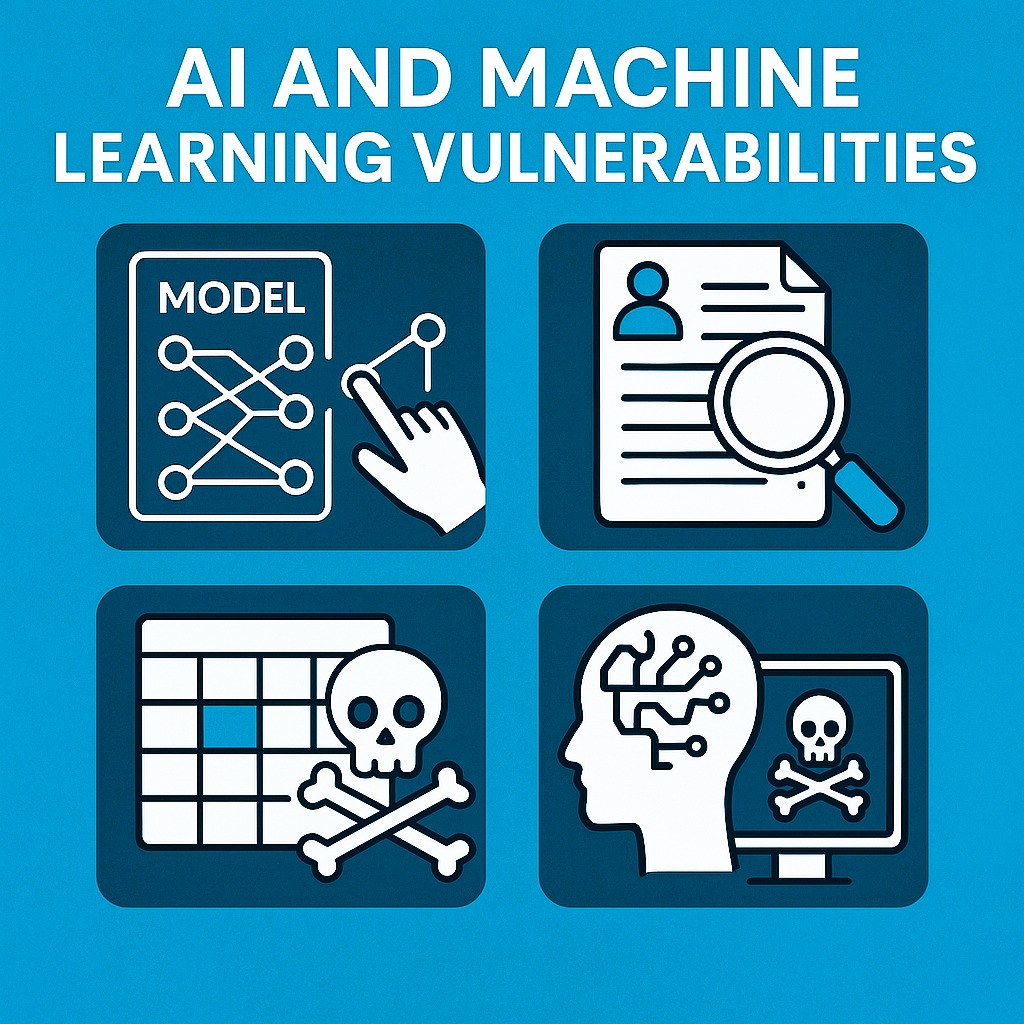
What You’ll Learn About AI ML Vulnerabilities in This Series
This blog series explores seven high-impact categories of machine learning risk. Each article breaks down real-world attack methods and gives you actionable insights to improve your AI defenses:
- Adversarial Attacks and Defenses in AI Models
Explore how attackers subtly manipulate input data to cause misclassification, and how defenders can apply adversarial training and model hardening techniques to resist exploitation. - Model Inversion and Membership Inference Risks
Learn how adversaries reconstruct training data or detect whether specific records were used to train a model—putting privacy and compliance at serious risk. - Data Poisoning and Backdoor Attacks in Machine Learning
Understand how corrupted data is injected during training to create bias, degrade performance, or embed logic bombs triggered only by specific inputs. - Model Stealing and Intellectual Property Risks
Delve into the methods used to reverse-engineer and clone proprietary models via exposed APIs, and how to prevent competitors and adversaries from replicating your IP. - Privacy-Preserving Machine Learning Techniques
Explore how technologies like differential privacy, federated learning, and homomorphic encryption can preserve user data confidentiality without sacrificing accuracy. - AI-Specific Supply Chain Security Risks
Pretrained models, shared datasets, and open-source ML components can introduce upstream threats. Learn how to validate, monitor, and secure your AI supply chain. - LLM-Specific Attacks and Defenses in Generative AI
Discover prompt injection, memory corruption, jailbreaks, and data leakage issues in large language models—and the emerging practices to secure generative AI systems like GPT and Claude.
Who Should Care About Machine Learning Risks?
This series is for anyone responsible for securing or building machine learning systems:
- Red teamers and penetration testers evaluating AI-powered infrastructure
- CISOs and enterprise architects working to close machine learning security gaps
- Data scientists and ML engineers interested in designing secure models
- Privacy officers and compliance managers navigating data exposure risks
Whether you’re using PyTorch, TensorFlow, or a commercial LLM, these AI ML vulnerabilities can have real and costly consequences if left unchecked.
Stay Ahead of the Curve in AI Security
Attackers are quickly adapting to the AI age. To keep your infrastructure secure, your defenses must evolve just as fast. This series will equip you with the understanding needed to assess, test, and defend against evolving threats in the world of AI.
What’s Next in This Series?
Explore the full AI and ML Vulnerabilities Series:
- Adversarial Attacks and Defenses
- Model Inversion and Membership Inference
- Data Poisoning and Backdoor Attacks
- Model Stealing and IP Risks
- Privacy-Preserving Machine Learning
- AI Supply Chain Risks
- LLM-Specific Attacks and Defenses
References Cited:
About The Author