In today’s interconnected world, government agencies and critical infrastructure operators face a constant barrage of cyber threats. From nation-state attacks targeting national defense systems to ransomware disrupting fuel supplies and public services, the operational, economic, and societal stakes are high. To mitigate these growing risks, organizations need robust and scalable incident response strategies that work across complex ecosystems.
This article explores how scalable incident response enhances resilience, outlines key frameworks and challenges, and presents real-world practices for defending critical services when it matters most.
Table of Contents
- Why Incident Response Must Scale
- Established Frameworks for Incident Response
- Common Challenges in Scaling Incident Response
- Best Practices for Effective, Scalable IR
- Real-World Applications and Case Studies
- Policy, Regulation, and the Future of IR
Why Incident Response Must Scale
Cyber incidents today are fast-moving, complex, and far-reaching. Many of the most impactful attacks of the last five years targeted not just IT systems, but critical infrastructure on which millions of people depend.
Consider the SolarWinds supply chain attack in 2020. Nation-state hackers compromised the Orion software platform, impacting over 18,000 customers—including U.S. federal agencies like DHS, Treasury, and Justice. The breach exposed systemic risks tied to third-party software dependencies and poor detection capabilities (bold and underlined**)¹.
Another landmark event was the Colonial Pipeline ransomware attack in 2021. An affiliate of the DarkSide group forced the company to shut down its fuel pipeline, causing fuel shortages across the Eastern U.S. It took weeks to recover fully—and highlighted the lack of preparedness in infrastructure response coordination (bold and underlined**)².
These incidents illustrate the need for an incident response (IR) model that scales—technically and operationally—to deal with cascading effects, cross-sector dependencies, and real-time decision-making.
Established Frameworks for Incident Response
Fortunately, organizations don’t need to start from scratch. Several government-published frameworks provide structured guidance for scalable and repeatable incident response planning.
National Cyber Incident Response Plan (NCIRP)
The NCIRP, developed by CISA, serves as a blueprint for managing significant cyber incidents across the public and private sectors. It establishes key roles, responsibilities, and coordination protocols among federal, SLTT (state, local, tribal, territorial), and private entities.
Unity of effort, shared situational awareness, and whole-of-nation collaboration are its pillars (bold and underlined**)³.
NIST Incident Handling Guide
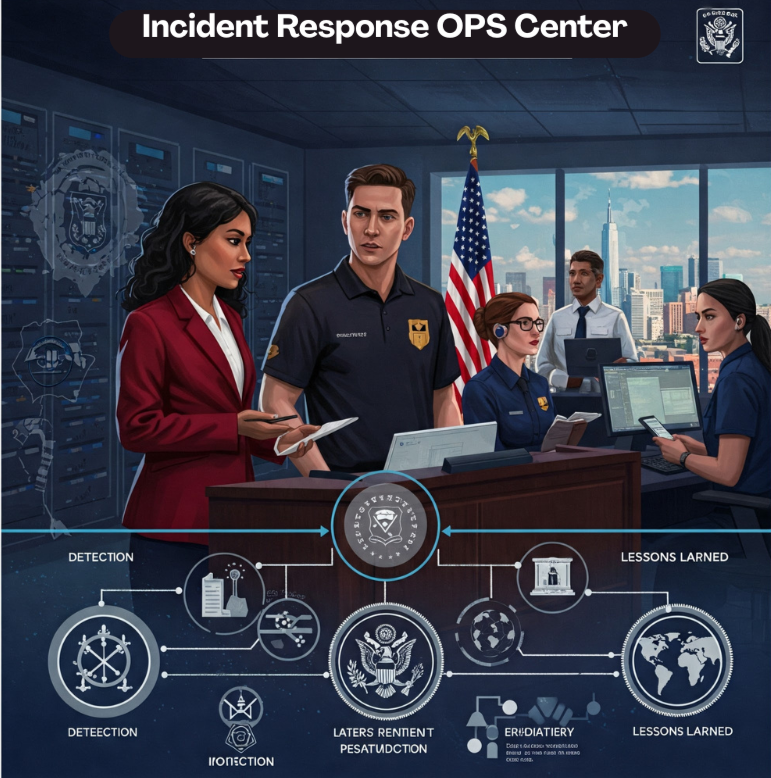
NIST’s Special Publication 800-61r2 outlines the incident handling life cycle: preparation, detection and analysis, containment, eradication and recovery, and post-incident activity.
While commonly used in enterprise settings, this guide scales effectively for government operations. Its structured approach allows incident response teams (IRTs) to prioritize actions and improve resilience iteratively (bold and underlined**)⁴.
CISA Playbooks
CISA released Federal Cybersecurity Incident and Vulnerability Response Playbooks to help agencies implement uniform processes. These playbooks include detailed workflows for incident containment, forensics, and stakeholder communications. Although aimed at federal use, the underlying principles can be tailored to state-level or private-sector infrastructure (bold and underlined**)⁵.
Common Challenges in Scaling Incident Response
Scaling incident response across sectors and jurisdictions introduces several operational challenges:
Limited Resources
Agencies often lack sufficient personnel or technology to support 24/7 threat detection and response. Smaller entities may operate with only a handful of IT staff, relying heavily on outdated tools or external assistance.
Fragmented Coordination
During an incident, especially one impacting multiple jurisdictions, effective response demands real-time coordination. Unfortunately, communication breakdowns and siloed processes remain common.
Complexity and Volume of Threats
Modern attackers exploit gaps in legacy systems, cloud services, and IoT devices. Their methods evolve faster than most agencies can update their defenses. This creates a moving target that traditional IR plans can’t easily address.
Regulatory Overhead
Compliance with frameworks like FISMA, CMMC, and state-level breach notification laws adds another layer of complexity. Delayed responses may lead not only to greater damage but also legal exposure.
Best Practices for Effective, Scalable IR
To overcome these challenges, organizations must evolve beyond checklists and into adaptive, proactive readiness. Below are key best practices for building a scalable incident response capability.
1. Establish Clear Communication Protocols
Create and test communication trees in advance. Define who talks to whom, how quickly, and using which secure channels. This clarity avoids chaos during an actual breach.
2. Conduct Frequent Exercises
Tabletop exercises, red team drills, hands-on-labs, and simulated ransomware events build readiness and confidence. CISA’s Cyber Storm exercises provide a model for interagency simulations at scale (bold and underlined**)⁶.
3. Integrate Threat Intelligence
Connecting to threat-sharing platforms like ISACs ensures rapid dissemination of emerging threats and IOCs (indicators of compromise). Integration with SIEM tools allows faster correlation and detection.
4. Build Modular, Scalable Tools
Adopt flexible technologies that scale with data volume and user demands—such as cloud-native security platforms, SOAR systems, and AI-driven detection.
5. Prioritize After-Action Reviews
After every significant incident or drill, conduct a comprehensive review to identify lessons learned, gaps, and updates to playbooks or tools.
Real-World Applications and Case Studies
State and Regional SOCs
The Center for Internet Security (CIS) has helped states create Regional Security Operations Centers (SOCs) for real-time threat detection and response. These shared services leverage centralized monitoring and intelligence across jurisdictions, enhancing both cost-efficiency and threat visibility (bold and underlined**)⁷.
Emergency Communications Centers (ECCs)
CISA’s published case studies showcase how ECCs across the country have handled real cyber events using collaborative planning, external vendor support, and effective IR playbooks (bold and underlined**)⁸. These examples prove that success doesn’t require massive budgets—just preparation, communication, and discipline.
Policy, Regulation, and the Future of IR
In 2022, the Cyber Incident Reporting for Critical Infrastructure Act (CIRCIA) was signed into law. It mandates that designated critical infrastructure entities report significant incidents to CISA within 72 hours—and ransomware payments within 24 hours.
These deadlines aim to provide federal responders with a broader threat landscape view, enabling faster containment and cross-sector coordination. Agencies are expected to build or adjust incident workflows around these reporting mandates (bold and underlined**)⁹.
Legislation like CIRCIA is just the beginning. Going forward, incident response will need to integrate with national resilience strategies, disaster recovery, and cross-border data-sharing agreements.
The Path Forward
As threats intensify, government agencies and critical infrastructure must respond with agility, precision, and unity. Scalable incident response isn’t just a cybersecurity function—it’s a mission-critical capability that safeguards public trust, economic stability, and national security.
By leveraging proven frameworks, embracing collaboration, and continuously testing their systems and teams, organizations can meet today’s cyber challenges head-on—and prepare for those yet to come.
References Cited:
https://www.cisa.gov/national-cyber-incident-response-plan-ncirp
https://www.cisa.gov/news-events/cybersecurity-advisories/aa20-352a
https://nvlpubs.nist.gov/nistpubs/specialpublications/nist.sp.800-61r2.pdf
https://www.cisecurity.org/insights/blog/albert-network-monitoring-guarding-state-local-governments
https://www.cisa.gov/real-world-case-studies
About The Author