Skip to content
The FedNinjas

The Fedninjas

FedNinjas: Your Guide to Federal Cloud, Cybersecurity, and FedRAMP Success.

Primary Menu
  • Home
  • Blog
  • Podcast
Listen to us on Spotify!

Adversarial Attacks and Defenses in AI Models

FedNinjas Team April 3, 2025 4 minutes read

Machine learning models are only as reliable as the inputs they receive—but what happens when those inputs are weaponized? Adversarial attacks in AI exploit the decision-making vulnerabilities of machine learning systems by subtly modifying input data to trick models into making incorrect predictions. These adversarial examples can cause critical failures in real-world applications, from facial recognition to autonomous driving.

This article dives into the mechanics of adversarial attacks, real-world risks, and the most effective strategies to protect your systems against these growing threats.

How Adversarial Attacks Work

Adversarial attacks on AI systems use slight, often imperceptible changes to input data to mislead machine learning models. These adversarial examples are carefully crafted to exploit the mathematical sensitivities of deep learning models, rather than breaking traditional code logic.

For example:

  • Slightly altering pixels in an image of a panda can cause a model to misclassify it as a gibbon.
  • Perturbing sensor data in a self-driving car can trick the model into misinterpreting street signs or lanes.
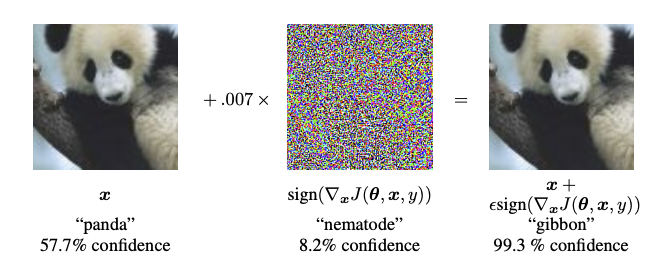
Source: TensorFlow Core – https://www.tensorflow.org/tutorials/generative/adversarial_fgsm

Popular techniques for generating machine learning attacks include:

  • Fast Gradient Sign Method (FGSM) – A fast, one-step method that applies calculated perturbations based on the model’s gradient.
  • Projected Gradient Descent (PGD) – An iterative method that produces stronger adversarial examples.
  • Carlini & Wagner (C&W) Attacks – Designed to bypass many traditional defenses with minimal changes to input data.

Why These Attacks Matter in Federal Systems

Federal environments face unique challenges when it comes to AI security. Mission-critical systems—from defense to public safety—are increasingly reliant on AI models. A successful adversarial attack could:

  • Cause misrouting in autonomous drones
  • Evade biometric identity verification systems
  • Fool malware classifiers in endpoint security platforms

Understanding how AI model hacking works is essential for any agency deploying machine learning in the field.

Common Targets of Adversarial Attacks

The AI attack surface includes any system that makes automated decisions based on incoming data. Frequent targets include:

  • Image classifiers in biometric surveillance
  • Speech recognition models for command-and-control systems
  • NLP models used in content filtering or sentiment scoring
  • Autonomous agents in navigation and robotics

Wherever inference occurs in real time, adversarial attacks can be used to degrade trust and reliability.

Defensive Strategies: Building Robust AI Models

The good news: multiple techniques exist to make your models more resilient against machine learning attacks. Here are the most effective:

1. Adversarial Training

One of the most widely used defenses, adversarial training involves retraining the model with both clean and adversarial examples.

  • Significantly increases AI robustness
  • Should be updated regularly to match evolving attack techniques

2. Gradient Masking and Obfuscation

By distorting the model’s gradient, attackers are unable to generate effective perturbations. However:

  • This can give a false sense of security if used alone
  • Best when paired with robust training or preprocessing

3. Input Preprocessing

Techniques like JPEG compression, noise removal, or quantization can strip away adversarial noise before the model sees the input.

  • May slightly impact accuracy
  • Often effective against low-effort adversarial examples

4. Ensemble Learning

Using multiple models in tandem can make systems more resistant to AI model hacking.

  • Diverse model architectures reduce the chance of a universal exploit
  • Especially useful for high-risk domains like defense and critical infrastructure

5. Certified Defenses

Mathematically guaranteed methods, like randomized smoothing, can certify model behavior within a specific input range.

  • Ideal for regulated environments
  • Offers formal guarantees of AI robustness

Case Study: Evading Public Surveillance with Adversarial Clothing

In 2021, a red team tested a public surveillance system by printing specially designed adversarial patterns onto clothing. These patterns confused the system’s AI model, allowing test subjects to avoid detection in more than 80% of trials.

The agency’s model lacked adversarial training and real-time preprocessing. After the test, they integrated adversarial training, edge-device filters, and ensemble modeling—cutting the success rate of similar attacks below 5%.

What’s Next in This Series?

Explore the rest of the AI and ML Vulnerabilities Series:

  • Adversarial Attacks and Defenses
  • Model Inversion and Membership Inference
  • Data Poisoning and Backdoor Attacks
  • Model Stealing and IP Risks
  • Privacy-Preserving Machine Learning
  • AI Supply Chain Risks
  • LLM-Specific Attacks and Defenses

Want the big picture? Start with the Parent Article: Exposing AI’s Weak Links

References Cited:

  1. Goodfellow, Ian J., et al. “Explaining and harnessing adversarial examples.” arXiv preprint arXiv:1412.6572 (2015).
  2. Carlini, Nicholas, and Wagner, David. “Towards Evaluating the Robustness of Neural Networks.” 2017 IEEE Symposium on Security and Privacy.
  3. Athalye, Anish, et al. “Obfuscated Gradients Give a False Sense of Security: Circumventing Defenses to Adversarial Examples.” ICML 2018.

About The Author

FedNinjas Team

See author's posts

Post navigation

Previous: Exposing AI’s Weak Links: Exploring Machine Learning Vulnerabilities
Next: Cracking the FedRAMP Code: Selling Cloud Services to the Government

Related Stories

Widening gap between information security and AI

The Widening Gap Between Information Security and AI

Eric Adams August 22, 2025
Cybersecurity future

The Future of Cybersecurity: Trends Shaping Tomorrow

Eric Adams June 12, 2025
cybersec in construction

Cybersecurity in the Construction Industry: Securing the Jobsite and the Back Office

FedNinjas Team May 7, 2025

Trending News

Claude Mythos and Project Glasswing: a Seismic Shift in Cybersecurity Claude Mythos and Glasswing Butterfly 1

Claude Mythos and Project Glasswing: a Seismic Shift in Cybersecurity

April 21, 2026
The Stryker Cyber Attack: A Mass Remote Wipe of its Managed Devices Stryker affected countries 2

The Stryker Cyber Attack: A Mass Remote Wipe of its Managed Devices

March 19, 2026
Agentic AI is the Attack Surface Agentic AI attack surfaces 3

Agentic AI is the Attack Surface

February 3, 2026
The Rise of Humanoid Robots in Modern Society Humanoid robots getting hackied 4

The Rise of Humanoid Robots in Modern Society

December 29, 2025
The Rise of AI Espionage: How Autonomous Agents Are Redefining Cyber Threats AI-orchestrated-cyber-espionage-campaign 5

The Rise of AI Espionage: How Autonomous Agents Are Redefining Cyber Threats

November 17, 2025
  • 3PAO assessments
  • Access Control
  • Advanced Threat Protection
  • Adversarial Modeling
  • Agentic AI
  • AI
  • AI and Quantum Computing
  • AI in Healthcare
  • AI-Powered SOCs
  • AI-Powered Tools
  • Anomaly Detection
  • API Security
  • Application Security
  • Artificial Intelligence
  • Artificial Intelligence
  • Artificial Intelligence in Cybersecurity
  • Attack Surface Management
  • Attack Surface Reduction
  • Audit and Compliance
  • Autonomous Systems
  • Blockchain
  • Breach Severity
  • Business
  • Career
  • CISA Advisory
  • CISO
  • CISO Strategies
  • Cloud
  • Cloud Computing
  • Cloud Security
  • Cloud Security
  • Cloud Service Providers
  • Compliance
  • Compliance And Governance
  • Compliance and Regulatory Affairs
  • Compliance And Regulatory Requirements
  • Continuous Monitoring
  • Continuous Monitoring
  • Corporate Security
  • Critical Infrastructure
  • Cross-Agency Collaboration
  • Cryptocurrency
  • Cyber Attack
  • Cyber Attacks
  • Cyber Deterrence
  • Cyber Resilience
  • Cyber Threats
  • Cyber-Physical Systems
  • Cyberattacks.
  • Cybercrime
  • Cybersecurity
  • Cybersecurity And Sustainability
  • Cybersecurity Breaches
  • Cybersecurity in Federal Programs
  • Cybersecurity Measures
  • Cybersecurity Strategy
  • Cybersecurity Threats
  • Data Breach
  • Data Breaches
  • Data Privacy
  • Data Protection
  • Data Security
  • Deepfake Detection
  • Deepfakes
  • Defense Readiness
  • Defense Strategies
  • Digital Twins
  • Disaster Recovery
  • Dwell Time
  • Encryption
  • Encryption Technologies
  • Federal Agencies
  • Federal Cloud
  • Federal Cybersecurity
  • Federal Cybersecurity Regulations
  • Federal Government
  • FedRamp
  • FedRAMP Compliance
  • Game Theory
  • GDPR
  • Global Security Strategies
  • Government
  • Government Compliance.
  • Government Cybersecurity
  • Healthcare
  • Healthcare Cybersecurity
  • Healthcare Technology
  • HIPAA Compliance
  • humanoid
  • Humans
  • Incident Response
  • Industrial Control Systems (ICS)
  • Information Security
  • Insider Threats
  • Internet of Things
  • Intrusion Detection
  • IoT
  • IoT Security
  • IT Governance
  • IT Security
  • Least Privilege
  • LLM Poisoning
  • Modern Cyber Defense
  • Nation-State Hackers
  • National Cybersecurity Strategy
  • National Security
  • Network Security
  • NHI
  • NIST Cybersecurity Framework
  • Operational Environments
  • Phishing
  • Privacy
  • Public Safety
  • Quantum Computing
  • Ransomware
  • Real-World Readiness
  • Red Teaming
  • Regulatory Compliance
  • Risk Assessment
  • Risk Management
  • Risk Management
  • Risk-Based Decision Making
  • robotics
  • Secure Coding Practices
  • Security Awareness
  • Security Operations Center
  • Security Operations Center (SOC)
  • Security Threats
  • Security Training
  • SIEM Tools
  • Social Engineering
  • Supply Chain Cybersecurity
  • Supply Chain Risk Management
  • Supply Chain Security
  • Sustainability
  • Tech
  • Technology
  • Third Party Security
  • Third-Party Risk Management
  • Third-Party Vendor Management
  • Threat Analysis
  • Threat Containment
  • Threat Defense
  • Threat Detection
  • Threat Intelligence
  • Threat Landscape
  • Training
  • Uncategorized
  • vCISO
  • Voice Phishing
  • Vulnerability Disclosure
  • Vulnerability Management
  • Workforce
  • Zero Trust Architecture
  • Zero Trust Authentication
  • Zero-Day Exploits
  • Zero-Day Vulnerabilities
  • Zero-Trust Architecture

You may have missed

Claude Mythos and Glasswing Butterfly

Claude Mythos and Project Glasswing: a Seismic Shift in Cybersecurity

Eric Adams April 21, 2026
Stryker affected countries

The Stryker Cyber Attack: A Mass Remote Wipe of its Managed Devices

Eric Adams March 19, 2026
Agentic AI attack surfaces

Agentic AI is the Attack Surface

Eric Adams February 3, 2026
Humanoid robots getting hackied

The Rise of Humanoid Robots in Modern Society

Eric Adams December 29, 2025
Copyright © All rights reserved.