The moment you understand what “CodeMender” can do, it becomes clear we’re approaching a paradigm shift in software security. CodeMender isn’t just another static analysis tool—it’s an autonomous AI agent designed to patch software vulnerabilities at scale. In this blog, we’ll explore the architecture, capabilities, use cases, challenges, and implications of CodeMender as described in DeepMind’s announcement, contextualizing it for cybersecurity professionals focused on code-level defense.
CodeMender Marks the Beginning of Autonomous Cyber Defense
Traditional automated security tools—static analyzers, fuzzers, and symbolic execution engines—have long supplemented human auditors. But as threat actors and red teams push state-of-the-art techniques, keeping pace through manual or semi-automated efforts becomes untenable. DeepMind introduces CodeMender as a solution: an AI agent that not only detects vulnerabilities, but also generates, validates, and upstreams fixes autonomously. Google DeepMind
In the span of six months, CodeMender has already upstreamed 72 security patches across open source projects—including some with over 4.5 million lines of code. Google DeepMind+1 That scale suggests CodeMender’s approach has passed an important early threshold: it is feasible to automate not just detection but high-assurance remediation.
The focus keyphrase for this discussion—CodeMender AI agent for code security—captures precisely what this technology seeks to achieve: shifted from reactive auditing to agentic, ongoing defense. For cybersecurity practitioners, this raises critical questions: How does it reason? What safeguards exist? Can it scale into enterprise environments or critical infrastructure?
How CodeMender reasons: architecture and validation pipeline
Integrating reasoning with program analysis
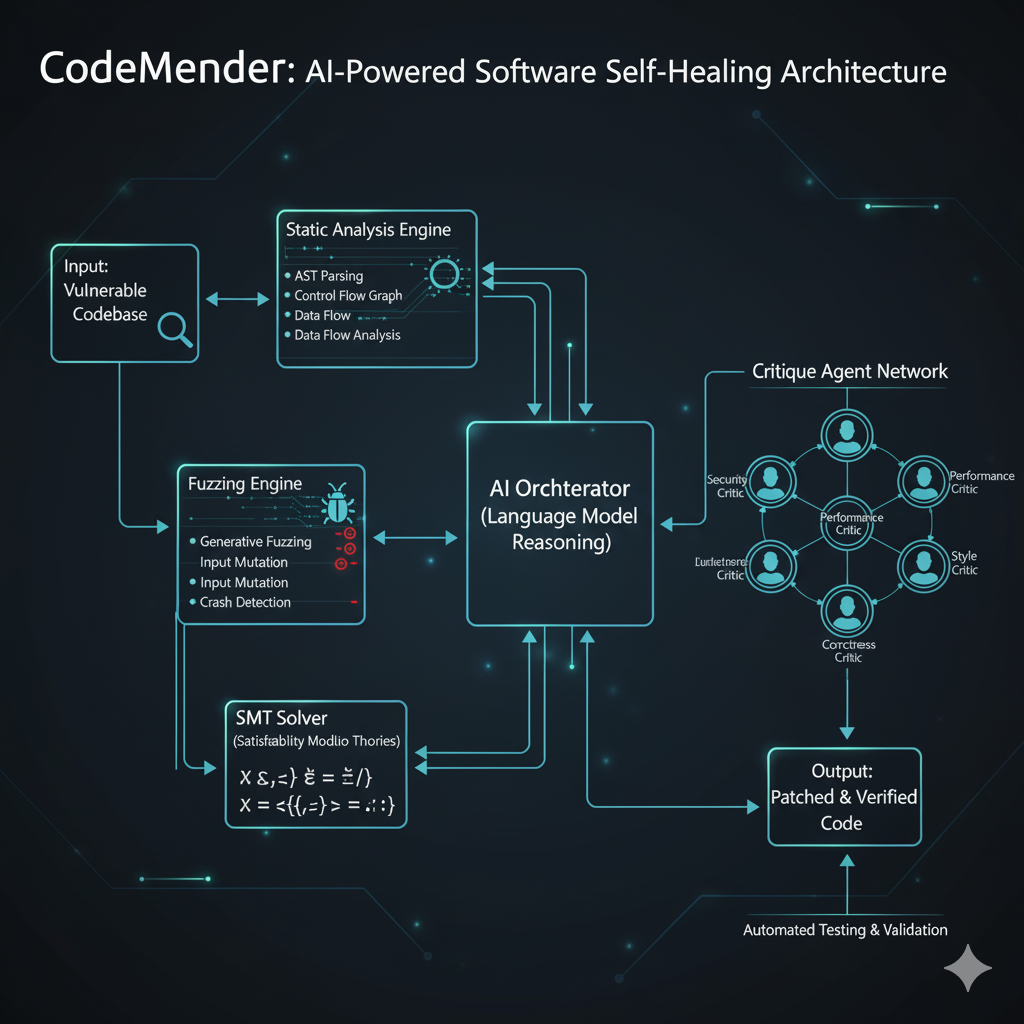
At its core, CodeMender combines advanced large-model reasoning (via Gemini Deep Think) with classic program-analysis tooling. It can execute deeper introspection than a pure LLM tasked with auto-patching. As DeepMind explains, the system leverages:
- Static analysis (dataflow, control flow, taint, symbolic reasoning)
- Dynamic analysis and fuzzing to explore runtime behavior
- Differential testing and SMT solvers to reason about constraints and corner cases
- A debugger + source‐code browser to localize root causes
- Multi-agent architecture, including specialized critique agents to judge patches and propose corrections. Google DeepMind+2MarkTechPost+2
This hybrid architecture enables CodeMender not only to propose a patch, but to understand whether that patch truly addresses the root cause without breaking existing behavior.
The validation and human-gating pipeline
A key strength of CodeMender lies in its cautious rollout: it does not blindly auto-commmit patches. Instead, any change must pass a validation pipeline that ensures:
- The patch fixes the root cause
- It is functionally correct
- It introduces no regressions
- It respects style and architecture constraints
- It survives full test suites
Only patches that satisfy these conditions are surfaced to humans for review. Google DeepMind+2MarkTechPost+2
This guardrail approach mirrors best practices in DevSecOps and keeps human oversight in the loop—critical when applying changes to production systems.
Multi-agent critique and self-correction
Inside the system, a specialized critique agent scrutinizes differences between original and modified code, looking for regressions or unintended side effects. If the critique agent flags defects, CodeMender self-corrects or searches alternative patches. Google DeepMind+1
This internal feedback loop is vital: it provides a layer of “self-audit” before the patch is even exposed to human reviewers.
Reactive and proactive security: two modes of operation
Reactive mode: immediate patching on vulnerability discovery
When a new flaw is found—by CodeMender’s own scanning or external signals—the agent can generate a patch immediately. This reactive capability helps narrow the “exposure window” that often plagues traditional vulnerability management programs. Google DeepMind+1
In one example, the bug appeared as a heap buffer overflow, yet the true root cause was in incorrect stack management during XML parsing. Though the final patch changed only a few lines, localizing the real issue demanded deeper reasoning—something CodeMender handled autonomously. Google DeepMind+2MarkTechPost+2
Proactive mode: rewriting existing code to eliminate entire vulnerability classes
Beyond patching instances, CodeMender also rewrites code to enforce safer idioms and eliminate entire vulnerability classes. For example, the agent applied -fbounds-safety annotations in libwebp to force compiler-enforced bounds checking across parts of the code. Google DeepMind+1
This is powerful: a heap buffer overflow exploited as CVE-2023-4863 would have been rendered non-exploitable had those annotations been present. Google DeepMind+1
If deployed broadly, this kind of prophylactic hardening could reshape how memory safety vulnerabilities are managed in C/C++ ecosystems.
Real-world examples and case studies
Example 1: Root cause reasoning with minimal patch footprint
In one case, a crash report triggered by a buffer issue turned out to be caused by incorrect stack handling of XML elements. CodeMender traced dependencies, inspected control flow, and applied a patch that modified just a few lines—but in the correct module to fully remediate risk. Google DeepMind+2MarkTechPost+2
Example 2: Object lifetime and custom code generation
Another case involved a complex system generating C code. The agent recognized a lifetime bug and modified the internal generator logic—nontrivial transformation compared to simple buffer fixes. The patch passed validation and was proposed upstream. Google DeepMind+1
Example 3: Bounds safety annotations in libwebp
Perhaps the most illustrative case is where CodeMender inserted -fbounds-safety annotations in parts of libwebp. That change enforces runtime bounds checking and would neutralize many buffer overflows in that region. Google DeepMind+2MarkTechPost+2
Of note, CodeMender can recover automatically from compilation errors or test failures caused by those annotations—rewriting surrounding code to preserve functionality. Google DeepMind
Technical challenges and risk vectors
Model uncertainties and hallucination risk
Large language models, especially when generating code, sometimes hallucinate or insert incorrect logic. In a security context, that’s unacceptable. DeepMind’s mitigation is the rigorous validation pipeline—but the underlying model uncertainty remains a risk. That’s why multi-agent critique and fallback strategies are critical.
Scalability, performance, and latency
The documents don’t yet disclose performance benchmarks. When integrated into large enterprise codebases (with monorepos spanning millions of lines across languages), the query latency, resource consumption, and validation cost become crucial. In production, that overhead must remain acceptable.
Code context, dependencies, and environment drift
A patch that works in isolation may fail in varied runtime environments—especially in microservices, dynamic linking, or cross-language calls. The agent must account for external dependencies, build configurations, and environment drift. The blend of static and dynamic analysis helps, but real-world complexity might expose edge cases.
Security of the agent itself
An autonomous agent with ability to mutate code becomes a dual-use target: adversaries might try to trick or hijack it. Ensuring the agent cannot be compromised (or manipulated via adversarial inputs) is essential. The wider space of agent security is nontrivial, and DeepMind’s Secure AI Framework (SAIF) 2.0 is part of their guardrail strategy. The Hacker News+2MarkTechPost+2
Community trust and maintainers’ acceptance
Open source maintainers may resist accepting machine-generated patches, especially where code ownership, design intent, or strategic direction are concerned. Gaining trust will require transparency, high patch quality, and incremental adoption.
Adversarial arms race between AI attackers and defenders
As defenders use agents like CodeMender, attackers will likely adopt AI-driven offensive tools. This raises the possibility of an escalating arms race—automated attack agents versus automated repair agents. A commenter on Hacker News warned:
“What if AIs get so good at crafting vulnerable (but apparently innocent) code that human review cannot reliably catch them?” Hacker News
That tension underscores the need for adversarial testing and red-teaming of security agents.
Implications for enterprise security programs
Augmenting DevSecOps pipelines
CodeMender-style agents could be integrated into CI/CD pipelines to auto-generate candidate patches for code scanning failures. The human gate ensures oversight, but the time-to-remediation shrinks drastically.
Shifting defensive focus from detection to remediative assurance
With remediation accelerated, defenders might shift resources upstream: investing more in code hardening, threat modeling, and architectural defense, instead of endless scanning.
Improved resource efficiency
Security teams often struggle with a backlog of triage issues. Automating low- to medium-risk patching frees skilled engineers to focus on advanced issues and incident investigations.
Open source supply chain hardening
Given that CodeMender has already submitted 72 fixes upstream, the open source supply chain stands to benefit. As more maintainers adopt such tools, libraries may acquire more robust defenses proactively.
Regulatory and audit considerations
Automated patches will need traceability, audit logs, and validation evidence to satisfy compliance frameworks (e.g. NIST, CISA, PCI-DSS). Ensuring that the AI’s decision-making is explainable and logged becomes important.
What to monitor as CodeMender evolves
- Benchmarks and validation studies: Watch for published papers detailing CodeMender’s scalability, false positives/negatives, and real-world impact.
- Public releases or SDKs: When (or if) DeepMind opens the agent to external users, adoption could accelerate defense capabilities across the industry.
- Agent security frameworks: Stay updated on DeepMind’s Secure AI Framework and approaches to protecting agent integrity.
- Adversarial testing tools: Tools like RedCodeAgent (an autonomous red-teaming agent for code agents) may emerge to probe systems like CodeMender. arXiv
- Benchmarks for secure code agents: Projects like SecureAgentBench, which evaluates code agents under realistic vulnerability scenarios, will be crucial for industry comparisons. arXiv
As CodeMender transitions from research demonstration to potential production-grade tool, its vision is bold: transforming vulnerability remediation from a bottleneck into a fluid, continuous process. For cybersecurity professionals, it foreshadows a future in which agents are first responders for code-level threats, augmenting teams rather than replacing them. While challenges remain—model fidelity, adversarial risks, and maintainers’ trust—the trajectory is clear: AI agents that reason, repair, and evolve code security may soon become essential infrastructure for resilient software systems.
References Cited
- DeepMind, “Introducing CodeMender: an AI agent for code security.” https://deepmind.google/discover/blog/introducing-codemender-an-ai-agent-for-code-security/
- CSO Online, “Google DeepMind launches an AI agent to fix code vulnerabilities automatically.” https://www.csoonline.com/article/4068774/google-deepmind-launches-an-ai-agent-to-fix-code-vulnerabilities-automatically.html
- MarkTechPost, “Google DeepMind Introduces CodeMender: A New AI Agent that Uses Gemini Deep Think to Automatically Patch Critical Software Vulnerabilities.” https://www.marktechpost.com/2025/10/07/google-deepmind-introduces-codemender-a-new-ai-agent-that-uses-gemini-deep-think-to-automatically-patch-critical-software-vulnerabilities/
- The Hacker News, “Google’s New AI Doesn’t Just Find Vulnerabilities — It Rewrites Code to Patch Them.” https://thehackernews.com/2025/10/googles-new-ai-doesnt-just-find.html
- Hacker News discussion, “CodeMender: an AI agent for code security.” https://news.ycombinator.com/item?id=45496533
- Guo et al., “RedCodeAgent: Automatic Red-teaming Agent against Diverse Code Agents,” arXiv preprint. https://arxiv.org/abs/2510.02609
- Chen et al., “SecureAgentBench: Benchmarking Secure Code Generation under Realistic Vulnerability Scenarios,” arXiv preprint. https://arxiv.org/abs/2509.22097
About The Author